




Why starting at 22 beats earning more at 35
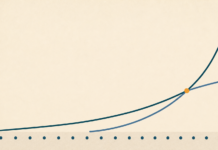
Time is the only input in investing you cannot buy later. Money you put in at 22 has about 43 years to grow before a normal retirement age. Money you put in at 32 has 33. Ten years does not sound like a third of anything, but because growth is exponential rather than linear, those ten years carry a wildly disproportionate share of the final number.
That’s the case for starting small and early instead of waiting until you feel financially serious. The rest of this article is about which moves actually deserve your attention in this decade, because the internet has the priorities almost exactly backwards.
The compounding math, three worked scenarios
Every figure below assumes a 7% annual return, compounded monthly, which is a reasonable stand-in for long-run stock market returns after inflation. Results are therefore in today’s dollars. Actual returns will be lumpier and nobody knows what they’ll be.
Scenario one: $200 a month starting at 22. Over 43 years you contribute $103,200 of your own money. At 65 you have roughly $655,000.
Scenario two: $500 a month starting at 32. Over 33 years you contribute $198,000, nearly double the first scenario. At 65 you have roughly $772,000.
You contributed almost twice as much and finished only 18% ahead. That’s the whole argument in one comparison.
Scenario three: same total, ten years later. Now hold the contribution constant. To put in the same $103,200 starting at 32 instead of 22, you’d save about $261 a month for 33 years. At 65 that gives you roughly $402,000.
Identical money in. A gap of about $253,000, which is more than double what either person contributed. That difference is purely the ten years.
One more that surprises people. Save $200 a month from 22 to 32, then stop completely and never contribute another dollar. Your $24,000 grows to roughly $323,000 by 65. Someone who starts at 32 and saves $261 a month for 33 straight years ends up with $402,000. They contributed four times as much and finished only 25% ahead.
A caution on all of this. If you assume 5% instead of 7%, scenario one drops from $655,000 to about $362,000. The ordering of the scenarios stays the same, but the absolute numbers are a projection, not a promise. Treat compound interest calculators as arguments for behavior, not as forecasts of your net worth.
What actually moves the needle in your 20s
Income growth, which dominates everything else
At 24, your savings rate is capped by arithmetic. If you earn $55,000 and live in a city, there’s a floor under your rent and groceries, and the absolute most you can free up by being disciplined is a few hundred dollars a month. Your income has no such ceiling.
Consider two people who both start at $55,000 at 22. One gets standard 3% annual raises and is earning about $81,000 at 35. The other switches jobs twice and averages 8% growth, reaching about $150,000. Over those thirteen years, the second person earns roughly $323,000 more in total. That gap is larger than every dollar the first person could plausibly have saved by cutting spending over the same period, and it keeps widening afterward.
This is why the highest-return activity in your 20s is usually not financial at all. It’s getting good at something people pay for, changing employers when your current one won’t match the market, negotiating offers instead of accepting them, and moving toward work that has room above it. A $15,000 raise at 25, with half of it invested, is worth about $1.6 million by 65 on the same 7% assumption.
Nobody selling you an investing course wants this to be the answer, because there’s no product attached to it.
Avoiding high-interest debt
Compound interest works the same in both directions, and credit card rates make it brutal. Carry a $6,000 balance at 22% APR and pay $150 a month, and you’ll spend 73 months clearing it and pay about $10,900 in total. Pay $300 a month instead and you’re done in 26 months having paid about $7,500.
There’s no investment that reliably returns 22%. Paying off a card at that rate is the closest thing to a guaranteed, tax-free return available to a normal person. Buy-now-pay-later balances and payday loans belong in the same category, and car loans on depreciating vehicles you can’t afford are the quiet version of the same mistake.
Student loans are different and deserve their own analysis. Federal loans at 5% with income-driven repayment options are not an emergency and generally shouldn’t be attacked ahead of an employer match. A private loan at 11% probably should be.
Employer match capture
If your employer matches 401(k) contributions and you don’t contribute enough to get the full match, you’re declining part of your compensation.
A 3% match on a $55,000 salary is $1,650 a year. Contributed monthly from 25 to 65, the match alone is worth roughly $361,000. That’s before counting anything you put in yourself.
Two details worth checking in your plan documents. The vesting schedule tells you how long you have to stay before the match is fully yours, and some plans use a cliff at three years. The match formula matters too: 50% of the first 6% is a very different thing from 100% of the first 3%, and the second one requires only half the contribution to max out.
What barely matters yet, despite the internet’s obsession
Coffee and subscription cutting
The math here is real, which is why the argument keeps working. Five dollars a day is $150 a month, and invested at 7% for 40 years that becomes roughly $394,000. Not nothing.
The problem is what the framing does to your attention. Cuttable spending has a hard ceiling of maybe $300 or $400 a month for most people in their 20s, and hitting it requires sustained deprivation for four decades, which nobody actually does. Meanwhile a single well-timed job change can add ten times that to your annual income permanently, with no ongoing willpower cost. One raise beats every latte you’ll ever skip, and it beats them without you thinking about it again.
Cancel the subscriptions you don’t use. It takes twenty minutes and it’s free money. Then stop thinking about it and go update your resume.
Stock picking and day trading
Most active traders lose money, and the research on this is consistent across decades and countries. The retail day trading studies out of Brazil and Taiwan found that the overwhelming majority of participants lost money over time, with a tiny fraction profitable enough to justify the effort.
Notice who funds and promotes the counter-narrative. Brokerages earn on volume and payment for order flow, so their incentive is your activity, not your returns. Trading educators earn on course sales. Neither is required to show you an audited track record, and almost none do.
In your 20s the amount at stake makes this doubly irrelevant. Turning $3,000 into $4,000 through brilliant stock selection is a 33% return and a $1,000 outcome. It’s also a full-time hobby. The same hours spent becoming better at your job move a number with far more zeros in it.
Optimizing between nearly identical funds
The difference between a broad index fund charging 0.03% and one charging 0.09% is $6 a year per $10,000 invested. People spend weeks on this decision.
Fee differences do matter, but the real distinction is between 0.05% and 0.75%, not between 0.03% and 0.09%. Pick a low-cost, broadly diversified fund, confirm the expense ratio is under about 0.2%, and move on. The forum debate you’re reading has crossed from optimization into procrastination dressed up as diligence.
The order of operations: a decision sequence
When a dollar arrives and you don’t know where it goes, work down this list. It’s not the only reasonable sequence, but it’s defensible at each step and it stops you from re-litigating the decision every month.
One: a starter emergency buffer. One month of expenses in a high-yield savings account, before anything else. Not because it earns much, but because without it, the first car repair goes on a credit card and you end up in the 22% problem described above.
Two: the full employer match. Contribute exactly enough to capture every matched dollar. This comes before debt payoff for almost everyone, because a 50% or 100% instant match beats even credit card interest as a rate of return.
Three: high-interest debt, hardest rate first. Anything above roughly 7% or 8%. Mathematically you attack the highest rate first. If you need psychological wins to stay consistent, paying the smallest balance first costs you a modest amount in interest and is still far better than quitting. Pick the one you’ll actually finish.
Four: finish the emergency fund. Three to six months of expenses, depending on how stable your income is and whether anyone depends on you. A freelancer needs more than a tenured government employee.
Five: Roth IRA. For 2026 you can contribute up to $7,500. Roth is usually the right call in your 20s because you pay tax now, at what will probably be the lowest rate of your career, and withdraw tax-free later. Direct Roth contributions phase out between $153,000 and $168,000 of income for single filers in 2026, which most people in this decade won’t hit.
Six: back to the 401(k), up to the limit. The 2026 employee contribution limit is $24,500. Few people in their 20s will reach it, and that’s fine.
Seven: a taxable brokerage account. No contribution limits, no early withdrawal restrictions, which makes it the right home for money you may want before 59 and a half, like a house down payment.
The main reason to write this down is that it removes the decision. You aren’t smarter for reconsidering it in March.
What “rich” realistically looks like on each timeline
$200 a month from 22 gets you to roughly $655,000 at 65 in today’s dollars. That’s a comfortable retirement supplement, not a private jet, and it’s the outcome of a decision most people can make at 22 without changing how they live.
$800 a month from 25, which usually requires the income growth discussed above rather than heroic frugality, lands somewhere around $2 million. That’s the realistic ceiling for a normal career with consistent investing, and it’s genuinely a lot. What it isn’t is fast. Anyone promising you a shorter path is selling the shorter path.
Common traps
Multi-level marketing companies publish their own income disclosures, and those documents consistently show that the large majority of participants earn little or nothing before expenses. That’s the sellers’ own data, not a critic’s estimate.
Prop firm challenge accounts charge you a fee to attempt a trading evaluation with rules calibrated so most attempts fail. The fee is the business model.
Paid signal groups and Discord trading rooms have no verified track record, no regulatory obligation to you, and every incentive to keep you subscribed rather than profitable. If someone could reliably predict markets, selling $99 monthly subscriptions would be a strange way to monetize it.