Why this is the most common first-money question
You have a few hundred dollars of breathing room each month for the first time. You also have a credit card balance and no savings. Every dollar can go to one place or the other, and the internet will confidently tell you both answers.
The reason the question keeps coming up is that both sides are right about something real. Debt has a knowable cost you can calculate to the penny. A missing emergency fund has an unknowable cost that shows up as new debt at a worse moment. This article works through the actual numbers so you can stop relitigating the decision.
The case for the fund first
The strongest argument for savings has nothing to do with interest rates. It’s that without a buffer, you can’t stay out of debt in the first place.
Here is what happens without one. You put every spare dollar toward a $5,000 credit card balance, and eight months in, your transmission fails and costs $1,500. There’s nowhere for that to go except back onto the card. You’ve made progress and then erased it, and you’ve done it while feeling disciplined the entire time. This cycle is why people carry the same balance for years despite genuinely paying it down every month.
Run it as numbers. With $400 a month and a $5,000 balance at 24% APR, you clear the card in 15 months having paid about $5,800 total. Add a $1,500 emergency in month eight that lands back on the card, and you’re at 20 months and about $7,900. The emergency cost you five extra months and $2,100, and $600 of that is pure interest you paid for not having cash on hand.
There’s a second argument that doesn’t show up in spreadsheets. Money in an account is money you control. A paid-down credit line is money the bank controls, and banks reduce limits and close accounts precisely when borrowers look shaky, which is exactly when you’d need it. Anyone planning to “just use the card in an emergency” is relying on a lender’s continued goodwill.
The psychological piece is real too. A buffer removes the low-grade dread that makes people avoid looking at their accounts entirely, and avoidance costs more than any interest rate.
The case for debt first
The counterargument is arithmetic and it’s hard to dispute.
A high-yield savings account today pays somewhere around 4% APY. The FDIC puts the national average across all savings accounts at 0.38%, so most people are earning less than that. A credit card at 24% is costing you six times what the best savings account pays you, and you owe income tax on the interest you earn while paying the card interest with after-tax dollars.
Every month you hold $3,000 in savings instead of applying it to a 24% card, that decision costs you about $60. Over a year, roughly $720. You’re paying that for the privilege of having cash available, and it’s a real price, not a rounding error.
Paying down high-rate debt is also the only guaranteed return available to a normal person. Investment returns are estimates. Eliminating a 24% balance returns exactly 24%, risk-free, permanently. Nothing in a brokerage account can promise that.
There’s a compounding wrinkle people miss. Credit card interest compounds daily, and if you’re only making minimum payments, the balance can grow faster than you’re shrinking it. That situation is genuinely urgent in a way that a slow-building savings account is not.
The interest rate threshold that decides it
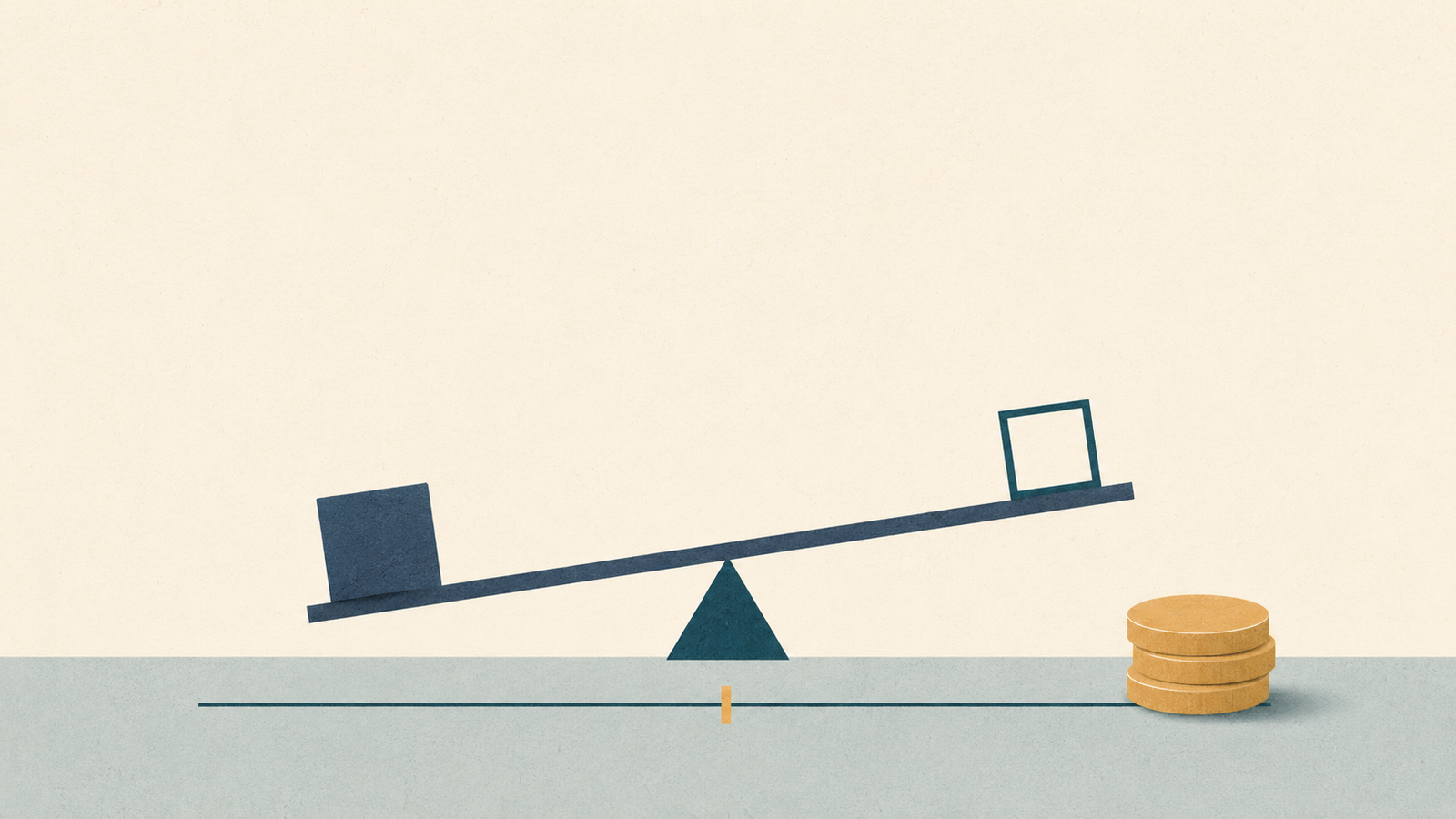
Compare what the debt costs you against what the savings earns you, and the gap tells you where the money should go. The dividing line lands somewhere around 8%.
Above roughly 8%, debt usually wins. The spread between a 4% savings yield and a double-digit borrowing rate is too wide to ignore. Credit cards, payday loans, buy-now-pay-later plans that convert to interest, and most personal loans live here.
Below roughly 8%, liquidity usually wins. When your debt costs 5% and your savings earns 4%, the real spread is about one percentage point. On a $10,000 balance that’s $100 a year, which is a small price for not being forced back onto a credit card the next time something breaks. Federal student loans, most mortgages, and subsidized car loans typically fall here.
The threshold isn’t a law of nature. It moves with savings rates. When high-yield accounts paid 0.5% back in 2021, the crossover sat lower. If savings yields fall again, more debt becomes worth paying early. Recalculate rather than memorizing the number.
Worked example at 24% APR. You have $5,000 on a card at 24% and $400 a month. Sending all $400 at the card clears it in 15 months for about $5,800 total. Splitting the money, $200 to the card and $200 to savings, stretches the payoff to 36 months and costs about $7,000. The split costs you roughly $1,200 in extra interest and 21 additional months of exposure. At this rate, the debt is a bleeding wound and you should treat it that way once you have a minimal buffer.
Worked example at 5% student loan. You have $20,000 in federal loans at 5% and $300 a month above the minimum. Aggressive payoff takes 79 months and about $3,500 in interest. Holding $5,000 in savings at 4% instead of throwing it at the loan costs you about $50 a year in net interest. Fifty dollars is what the liquidity costs. Meanwhile, federal loans carry deferment, forbearance, and income-driven repayment options if you lose your job, which is protection a credit card will never offer you. Paying these off early is a preference, not an emergency.
The hybrid approach most people should use
Almost nobody should pick one side purely. The sequence below is what the arithmetic actually supports.
Step one: a starter buffer of $1,000 to $2,000, fast. Do this before aggressive debt payoff regardless of your interest rate. Yes, holding $1,500 against a 24% card costs about $30 a month. That’s the price of not restarting from zero the next time a tire blows, and it’s cheap insurance. Build it in weeks, not months, by temporarily paying minimums on everything.
Step two: capture any employer 401(k) match. A 50% or 100% instant match on your contribution beats even a 24% card as a rate of return. This is the one thing that jumps ahead of high-interest debt.
Step three: attack debt above 8%, highest rate first. Everything spare goes here. Minimums only on everything else. Mathematically, targeting the highest rate first saves the most money. If you need visible progress to stay consistent, clearing the smallest balance first costs a modest amount extra and is far better than losing momentum and quitting. Choose the version you’ll actually finish, not the one that’s optimal on paper for someone else.
Step four: build the full emergency fund. Now go to three to six months of expenses, sized as described below.
Step five: everything under 8%, on your own timeline. Pay the minimums, invest the difference, or pay it down faster if carrying debt genuinely bothers you. That’s a legitimate preference and it costs you very little at these rates.
Two adjustments. If your job is unstable or your industry is laying people off, weight the buffer heavier and get to three months before attacking debt hard. If you have stable employment, a working partner, and family who could cover a gap, a smaller starter buffer is defensible.
How large the buffer needs to be at your life stage
The standard advice of three to six months of expenses is a range, not a number, and where you land inside it depends on how volatile your income is and how many people depend on it.
Expenses means essential expenses. Rent, utilities, groceries, insurance, minimum debt payments, transportation. It does not mean your entire monthly spending including travel and restaurants, which is how people talk themselves into thinking they need $40,000 and then save nothing.
A single person with steady salaried work, no dependents, and marketable skills can reasonably run three months. If you lose the job, you can cut spending immediately and you only have yourself to relocate or house-share.
A single-income household with children needs six months or more. More people depend on the income, expenses are less compressible, and job searches take longer at senior levels.
Freelancers, commission workers, and anyone in a seasonal industry should target six to twelve months. Your income already fluctuates, so the buffer is doing double duty as cash flow smoothing, not just disaster coverage.