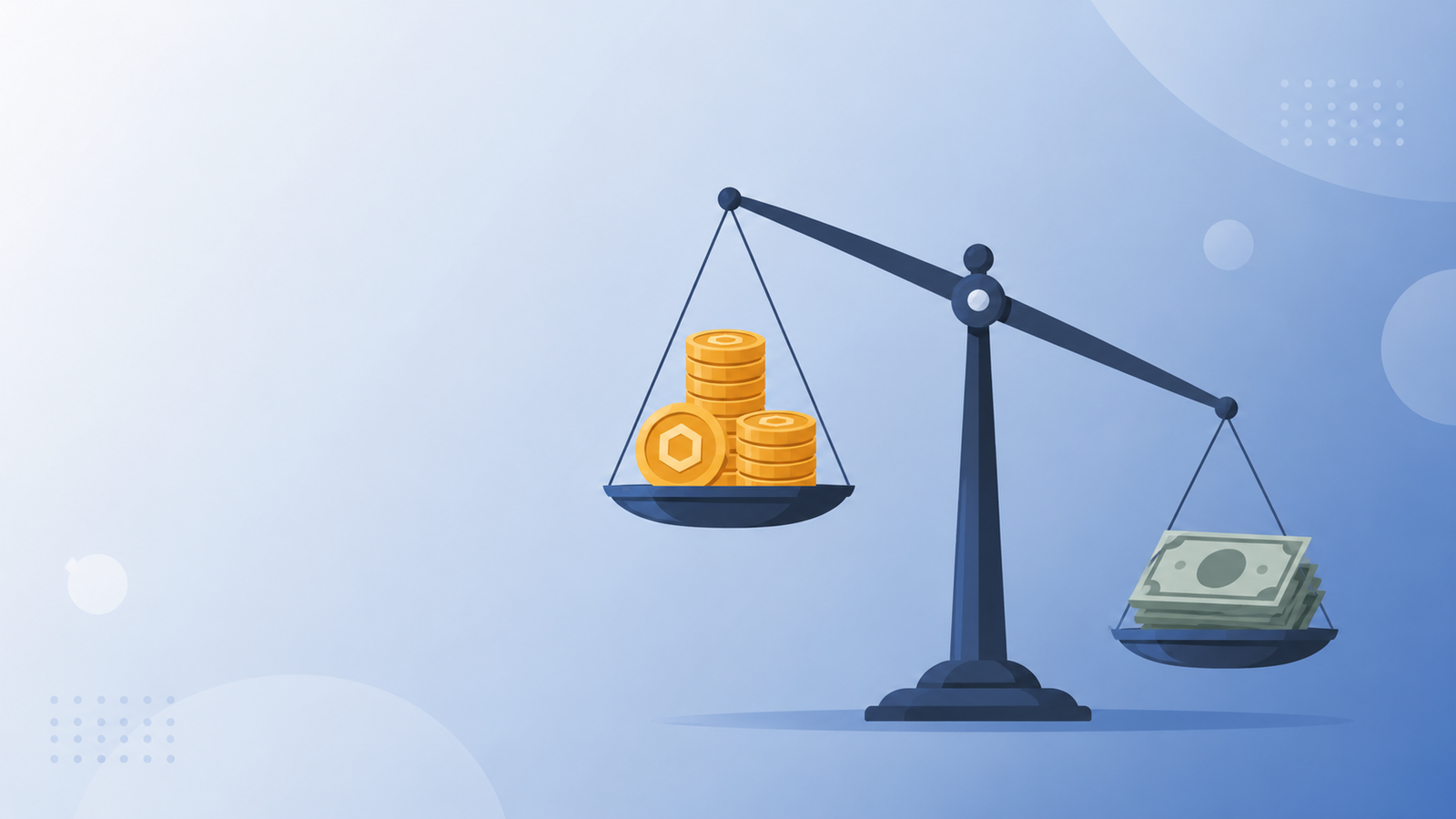
Robux has two prices, and they are not close to each other.
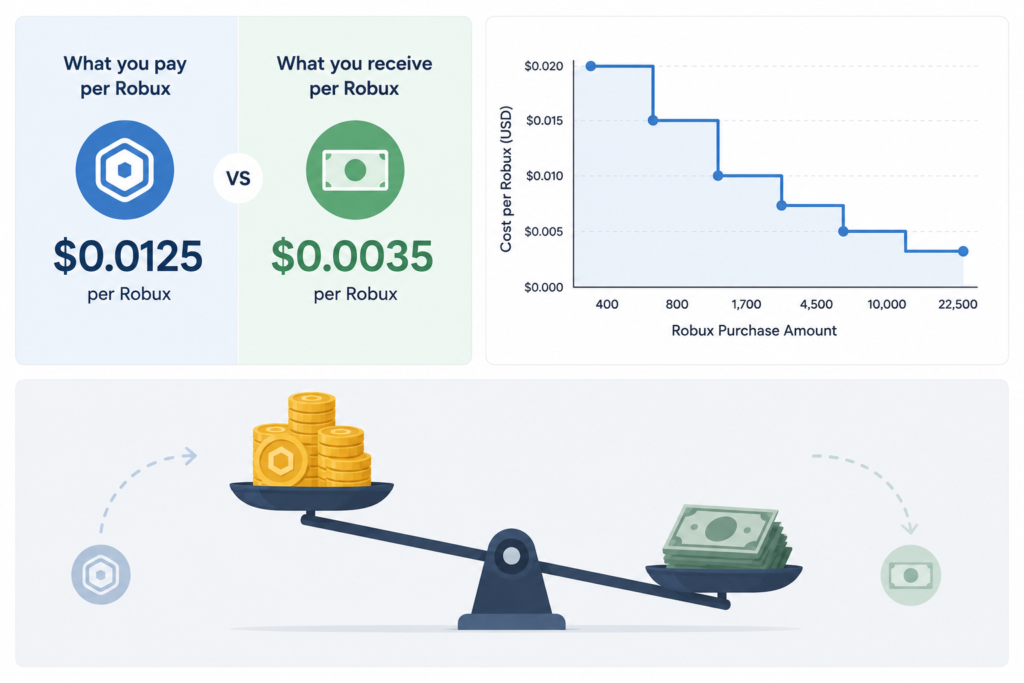
Buying it costs roughly one cent per Robux, sometimes a bit more, sometimes a bit less depending on how you pay. Converting it back through Roblox’s Developer Exchange pays $0.0038 per Robux at the standard rate. That’s a gap of about three to one in the same direction every time: expensive going in, cheap coming out.
Neither number is secret. Both are published by Roblox. But they live in different parts of the site, and almost nobody sees them side by side, which is why “how much is 10,000 Robux worth” gets answered with $99.99 by one person and $38 by another and both are right.
The short answer
Buying: about $0.010 per Robux on the Roblox website or with a gift card, and about $0.0125 per Robux inside the mobile app. Larger packages cost less per unit.
Cashing out: $0.0038 per Robux at the standard DevEx rate, $0.0054 for eligible spend from age-verified adult US players, and $0.0035 for Robux earned before September 2025. Only creators with earned Robux can cash out at all.
So a Robux you buy for a penny returns roughly a third of a penny if a creator eventually converts it. Everything below explains where the rest goes.
What Robux costs to buy
The purchase tiers
Roblox sells fixed packages rather than arbitrary amounts. These are the US app-store prices, which act as the baseline:
| Package | Price | Cost per Robux | Robux per dollar |
|---|---|---|---|
| 400 | $4.99 | $0.0125 | 80 |
| 800 | $9.99 | $0.0125 | 80 |
| 1,700 | $19.99 | $0.0118 | 85 |
| 4,500 | $49.99 | $0.0111 | 90 |
| 10,000 | $99.99 | $0.0100 | 100 |
There is no $1 package and no official dollar-to-Robux rate. The closest thing to one is the biggest package, where the math lands on a clean 100 Robux per dollar.
Why bulk buying costs less per unit
The 10,000 package gives you 25% more Robux per dollar than the 400 package for the same money spent. That’s a real discount available to everyone with no subscription attached, and it’s the simplest lever anyone has.
The catch is obvious: it only saves money if you were going to spend the whole thing. Buying 10,000 Robux to get a better rate and then using 900 of them is not a saving, and Roblox is well aware that a large balance sitting in an account tends to get spent.
Premium subscriber bonuses
Roblox Premium comes in tiers that include a monthly Robux stipend, commonly 450, 1,000, or 2,200 Robux depending on which tier you’re on. Premium members also receive a bonus on direct Robux purchases, generally reported at 10%.
For anyone spending Robux every month, the stipend alone usually justifies the subscription cost, which makes Premium a better deal than most people assume. Worth noting for creators: the stipend Robux are not earned Robux and can never be cashed out through DevEx.
The platform gap, which is the biggest single factor
This is the part that costs casual buyers the most money.
Roblox gives up to 25% more Robux when you buy on the web, on a computer, or with a gift card, compared to buying inside the iOS or Android app. Roblox states this is permanent global pricing, not a promotion.
In practice, that turns $4.99 into roughly 500 Robux on the web instead of 400 in the app, and $9.99 into roughly 1,000 instead of 800. Same money, same account, about 20 to 25% more currency for opening a browser instead of tapping the button in the app.
The reason is Apple and Google, who take a commission of around 30% on in-app purchases. Roblox is passing that cost through rather than absorbing it, and simultaneously nudging users toward the channel that doesn’t cost it a third of the transaction. Roblox’s own announcement of the change came shortly after app store fees drew regulatory attention worldwide.
The uplift is “up to” 25% and varies by tier and region, so check the amounts on your own purchase screen rather than assuming a fixed number.
What Robux is worth when you cash out
Going the other direction, only creators participate, and only with earned Robux.
The Developer Exchange converts earned Robux to US dollars at $0.0038 each as of 2026. Robux earned before 10am PT on September 5, 2025 converts at the older $0.0035, and a newer rate of $0.0054 applies to eligible spending from age-verified players over 18 in the United States. Minimum cash-out is 30,000 earned Robux, which is $114 at the standard rate.
Robux you bought, received as a gift card, got as a Premium stipend, or acquired through trading cannot be converted at any rate. There is no path from purchased Robux back to money. The exchange runs one direction and only for creator earnings.
It’s worth framing the spread accurately rather than as a scandal. Roblox is not running a currency exchange with an unfair margin. It’s running a platform where the currency is a product it sells, and the gap between the sale price and the payout rate is the revenue that funds the servers, the engine, the moderation, the payment processing, and the company. Every closed platform economy works this way. Apple keeps 15 to 30% of App Store revenue, Steam keeps 30% of game sales, YouTube keeps 45% of ad revenue on standard videos. Roblox’s effective take is larger than those, but it’s the same category of arrangement, not a different one.
What’s fair to criticize is legibility. The buy price, the marketplace fee, and the DevEx rate are published in three separate places, and the combined effect is not shown anywhere.
Side by side
Buy price uses app-store pricing, DevEx value uses the standard rate.
| Robux | Cost to buy | DevEx value | Creator gets |
|---|---|---|---|
| 400 | $4.99 | $1.52 | 30% |
| 800 | $9.99 | $3.04 | 30% |
| 1,700 | $19.99 | $6.46 | 32% |
| 4,500 | $49.99 | $17.10 | 34% |
| 10,000 | $99.99 | $38.00 | 38% |
The right-hand column is not the developer’s actual take, and this is where most articles stop too early. The DevEx rate applies to Robux that already reached the creator’s balance, and Roblox takes a 30% marketplace fee on game pass and developer product sales before that happens.
Run a real purchase all the way through. A player buys 800 Robux for $9.99 in the app and spends all of it on a developer product in your experience. Roblox takes 30% at the point of sale, leaving you 560 Robux. At $0.0038 each, that’s $2.13.
The player spent $9.99. The creator receives $2.13, or about 21%, before income tax. At the 18+ rate the same purchase returns $3.02.
Why the two numbers differ
Revenue share. The 30% marketplace fee on in-experience purchases is the largest single deduction, and it applies before the exchange rate does.
App store fees. Roughly 30% of the original payment goes to Apple or Google on mobile purchases, before Roblox sees any of it. This is why the platform gap exists at all, and it’s a cost Roblox is passing on rather than one it invented.
Currency control. Roblox needs the conversion to be one-directional and reviewed. A freely convertible virtual currency becomes a money transmission business, with licensing, anti-money-laundering, and sanctions obligations in every country it touches. A wide spread and a manual review process keep Robux classified as an in-platform credit.
Platform costs. Servers, engine development, moderation at the scale a platform with millions of minors requires, and payment processing all come out of the difference.
The grey market and why it doesn’t count
You’ll find sites and individuals quoting better rates in both directions: cheaper Robux than Roblox charges, or cash for Robux above the DevEx rate. Some are outright fake. Some genuinely deliver.
None of them are safe, for reasons that have nothing to do with whether the seller is honest.
Selling or transferring Robux outside official channels violates Roblox’s Terms of Use. Enforcement lands on the account that received or sent the Robux, and account termination means losing your entire balance, your inventory, your experiences, and your earning history. A developer with a working game risks vastly more than the discount is worth.
The mechanics also invite fraud on the buyer’s side. Off-platform Robux transfers typically move through group funds, fake game passes, or overpriced items, all of which are traceable. Chargebacks on the original purchase claw the Robux back afterward, leaving the recipient short and flagged. And “free Robux generators” are universally scams; Roblox states plainly that no such thing exists, and the sites exist to harvest account credentials.
The one legitimate discount worth knowing about: retailer gift cards go on sale. Walmart, Target, Amazon, and GameStop discount them during major sale periods, and a discounted gift card redeemed on the web stacks with the 25% web bonus. That’s an official channel with a real saving and no account risk.
What Robux actually buys
The abstract rate matters less than what the currency does, so here are rough ranges.
Game passes typically run from about 25 Robux for something small up to several hundred for a substantial unlock. Most sit between 50 and 500.
Avatar clothing is usually 5 to 100 Robux. Accessories and animation bundles run higher, commonly 75 to 350. Limited items trade on a resale market where prices can reach into the tens or hundreds of thousands, driven by scarcity rather than anything intrinsic.
Paid access experiences generally charge 25 to 100 Robux to enter, though this is rare since almost everything on the platform is free to join.
A useful mental conversion: at web pricing, 100 Robux is about $1. So a 400 Robux game pass is roughly a $4 purchase, and a 75 Robux hat is about 75 cents. Doing that conversion in your head before buying is the single most useful habit for anyone, especially a parent watching the spend.
That conversion also reframes the total. A child asking for “just 800 Robux” is asking for a $10 purchase, and a run of small in-experience buys that each feel trivial adds up the way small app purchases always have. Roblox reports that around 27 million users make a purchase in a typical month, which is a small fraction of its daily userbase but a very large number of transactions.
Worth knowing: Roblox has spending controls in parent account settings, including monthly limits and purchase notifications. They exist, they’re free, and most families never turn them on.
Does Robux hold value over time?
No, and it’s worth being clear about why.
Robux earns no interest and does not appreciate. A balance sitting in your account for three years is worth exactly the same number of Robux, while the dollars you spent on it have lost purchasing power to inflation. Holding it costs you something quietly.
Item prices move, but they move in Roblox’s favor more often than not. Roblox has adjusted package sizes and pricing several times, and the DevEx rate itself has changed twice recently after years unchanged. Both directions are set by one company with no obligation to consult anyone.
The value is entirely platform-dependent. Robux has no existence outside Roblox, no secondary market that Roblox permits, and no redemption right. If the platform changes its rules, your balance changes with it, and there’s no appeal.
Treat it as a spending currency, the way you’d treat a store gift card. Buy it when you’re about to use it, buy on the web rather than in the app, and don’t accumulate it as savings. For creators, the reverse applies: cash out earned Robux when you cross the threshold rather than letting a balance sit, since a rate that has moved twice in a year can move again.